Fallout Works Because the Apocalypse Came With a Brochure
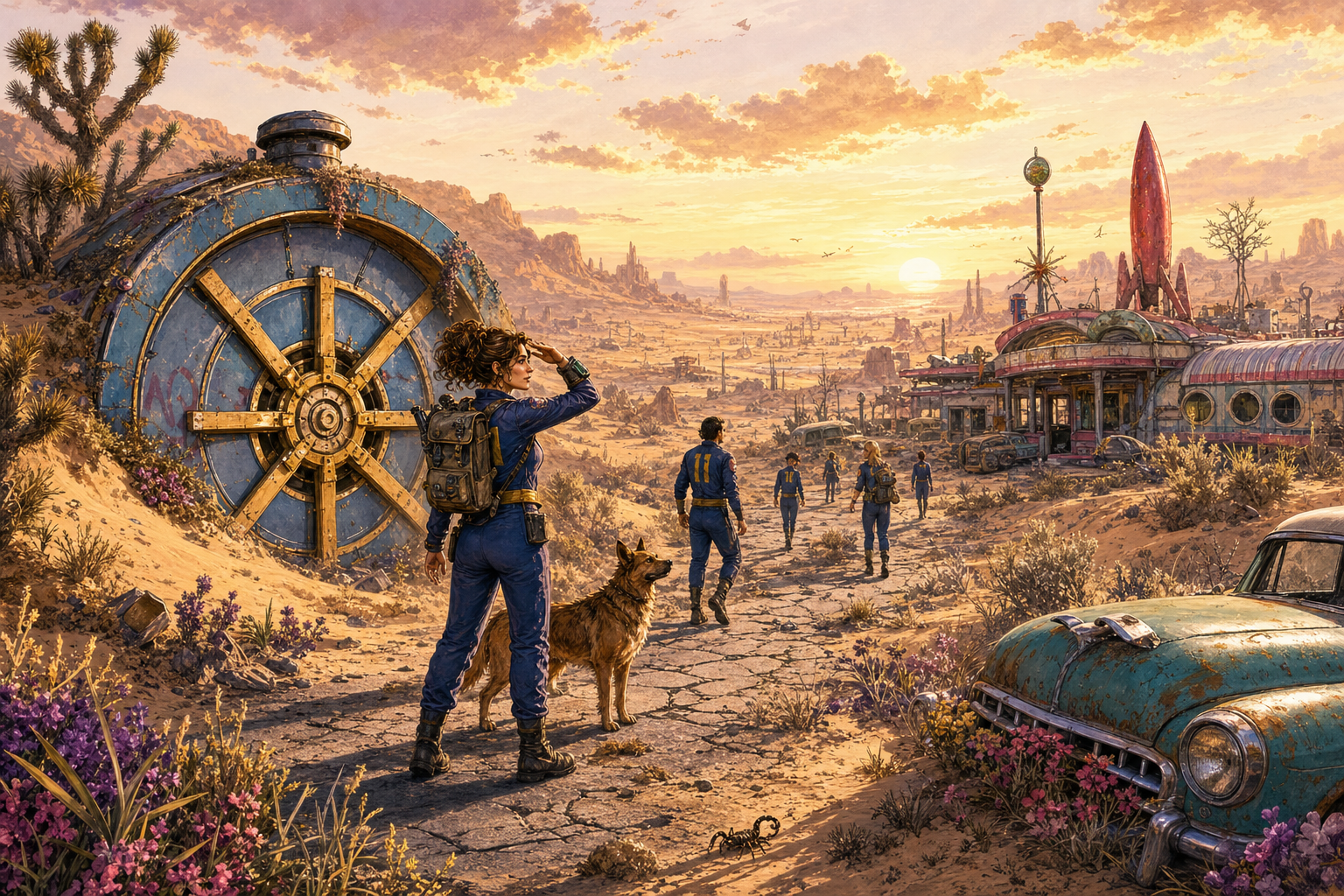
Why Fallout’s cheerful disaster satire feels so funny, bleak, and weirdly comforting all at once.
Fallout Works Because the Apocalypse Came With a Brochure
Fallout is funny because the end of the world has excellent branding.
That is the whole terrible biscuit.
The bombs fall. Society breaks. Giant insects begin their freelance era. Somewhere, in a vault with laminated rules and a suspiciously cheerful colour scheme, a person in a blue jumpsuit is being told to remain calm by a cartoon man with perfect hair.
This is why Fallout keeps working, across games, the Amazon show, and every new person who wanders into the wasteland and immediately meets a man selling bottled water near a skeleton.
The joke lands because the smile never drops.
Vault-Tec is the grandmaster of this. The vaults are sold as safety, family, good planning, sensible drills, the sort of thing a man in a short-sleeved shirt would explain with a pointer while everyone quietly dies inside. Then you find out half the vaults were experiments with the moral texture of wet cardboard.
A vault in Fallout never feels like a secret dungeon first. It feels like a school open evening where the headteacher has locked all the doors.
There are posters. There are routines. There are approved meals. There is probably a clipboard. The horror is wearing a badge and asking everyone to form an orderly queue.
That is the trick: Fallout does not simply show us disaster. It shows us disaster with a welcome pack.
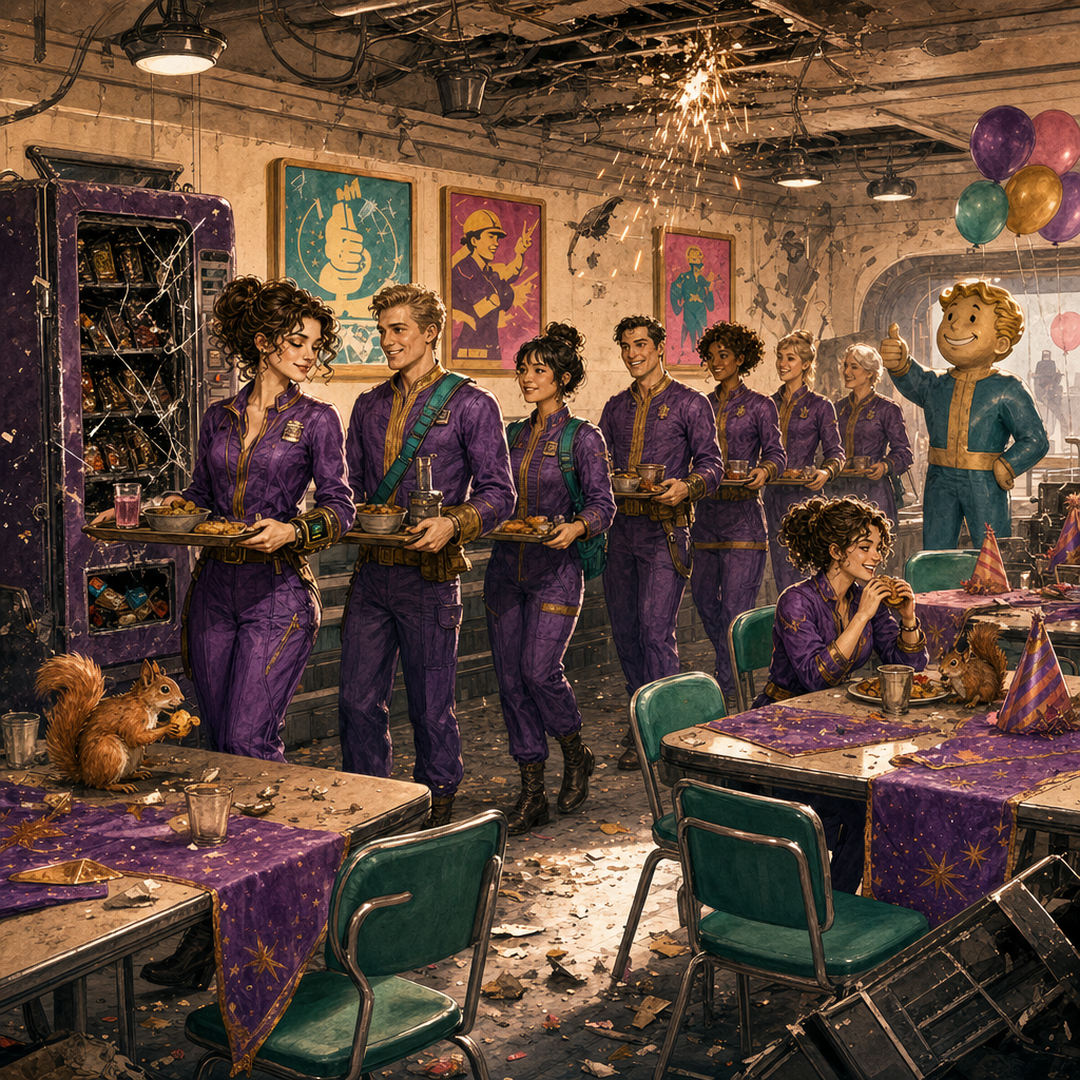
Vault Boy matters because he is the face of that joke. He grins through radiation, injury, addiction, weapon skills, barter, death, and the steady collapse of everything that was meant to protect people. He is not there to comfort us because everything is fine. He is there because someone, somewhere, decided the proper response to catastrophe was a clean mascot system.
Which, regrettably, feels familiar.
We know this tone. The bright little safety voice. The cheerful instruction during obvious trouble. The form letter after the incident. The soothing graphic beside news that should probably make someone put down their sandwich.
Fallout turns that into a whole world.
Every faction has its own brochure version of reality.
The Brotherhood of Steel has the energy of men who found a cupboard full of ancient weapons and built a church around the cupboard. The New California Republic has paperwork, uniforms, ideals, problems, and the exhausted face of any group trying to rebuild society with a stamp pad. Raiders have skipped the brochure and gone straight to interior decorating with bones, which is at least honest, if difficult for guests.
Nobody in Fallout simply wants power. They want power with a look, a speech, a costume, a flag, a story about why their mess is the correct mess.
That is why the satire feels so rich. The world ended, but people kept making brands. They kept making little systems. They kept deciding who gets a uniform and who has to stand outside with a pipe pistol.
And then there is Lucy.
In the show, Lucy begins with the full vault-approved belief that the world can be handled with manners, optimism, and a firm grasp of procedure. She steps into a place where politeness is still useful, but only after you check whether the chicken has two heads and the stranger has a knife.
Her goodness is funny because it has been packaged so neatly. It is also moving because it is real.
Fallout’s best joke has always had that little ache under it. The cheerful surface is absurd, but the longing underneath is very human. People wanted safety. People wanted order. People wanted a future with clean walls and smiling children and perhaps one normal tomato.
The tragedy is that the systems promising all that were often rotten before the bombs arrived.
So why is Fallout so popular?
Because it lets us laugh at the gap between the sales pitch and the wreckage.
Because it gives the apocalypse a jingle and then lets us notice how awful that is.
Because the wasteland is full of monsters, but the scariest thing is still a confident institution with a friendly mascot and a plan.
And because, somehow, under all the cracked helmets and bottle caps and cheerful little thumbs-ups, Fallout still believes people might crawl out, blink at the daylight, and try again.
Probably after looting a desk fan.
For civilisation.